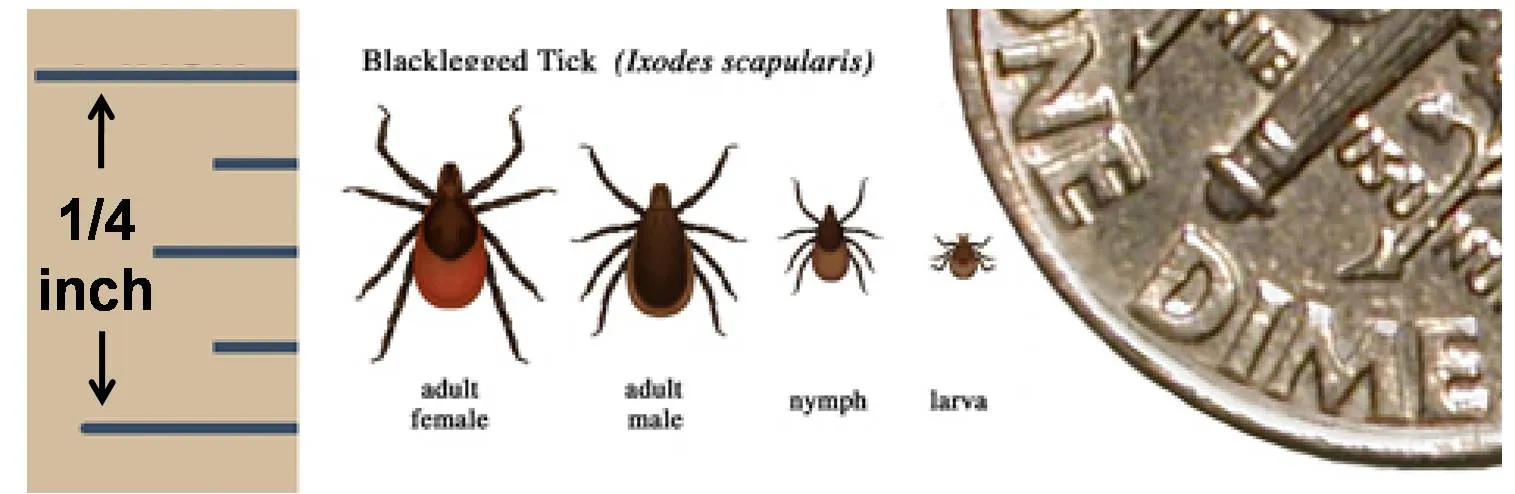

Quick answer: Use two layers. Treat the clothes and shoes you wear outside with a 0.5% permethrin product, which the CDC recommends [3], and put an EPA-registered repellent such as 20% picaridin or 30% DEET on exposed skin [3][4]. Then do a full tick check when you come in [3].
At a glance
- Lyme disease, New Jersey 2025
- Nearly 6,600 reported cases (preliminary) [1]
- Highest counts
- Hunterdon, Morris, Monmouth and Ocean counties [1]
- Anaplasmosis, 2025
- Over 300 cases, the most ever reported in the state [1]
- 2026 so far
- 4,570 Lyme cases through week 35, below the four-year average [2]
- Skin repellents CDC lists
- DEET, picaridin, IR3535, OLE, PMD, 2-undecanone [3]
Ticks in New Jersey
Lyme disease is the most reported tickborne disease in New Jersey. The state Department of Health’s preliminary count for 2025 was nearly 6,600 cases, higher than 2024 and in line with the three-year average [1]. The largest numbers were in Hunterdon and Morris counties in the northwest and in Monmouth and Ocean counties along the central coast [1].
Lyme isn’t the only concern. The department says alpha-gal syndrome had the second-highest case count of any tickborne illness in 2025, and anaplasmosis passed 300 cases for the first time [1]. Through week 35 of 2026, the state had 4,570 Lyme cases, running below its four-year average [2]. Cases peak during the nymph season that begins in late May and rise again in the fall adult season [1], so a bottle of repellent belongs by the back door from spring through November.
How we chose
- CDC-recommended ingredients only. Every pick uses an active ingredient the CDC recommends for tick bite prevention: DEET, picaridin or OLE on skin, or 0.5% permethrin on clothing [3].
- EPA label checked. Where we could match the product to its EPA registration, we read the EPA-accepted label and quote only what it says. We make no health claims beyond the label and the CDC.
- One of each type. One clothing treatment and three skin repellents with different active ingredients, so you can pick by preference and age.
- Recall check. Repellents are regulated by the EPA, not the CPSC, but we still searched the CPSC recall database for each brand on November 7, 2026. None turned up.
Our picks
Best for: Treating shoes, socks and yard clothes
Ranger Ready Permethrin 0.5% Clothing and Gear Repellent, 24 oz. Trigger Spray (Scent Zero)
Permethrin on clothing is the step most people skip. You treat your hiking or gardening outfit once outdoors, let it dry, and it keeps working through several washes. The EPA-accepted label lists ticks, including those that may carry Lyme disease.
- 0.5% permethrin, the strength the CDC recommends for clothing [3]; EPA Reg. No. 93221-2 [6]
- Label says protection lasts a minimum of six weeks and holds up through several machine washings [6]
- Let treated clothes dry at least 2 hours, or 4 hours in humid weather, before wearing [6]
- Label says not to retreat clothing more than once every six weeks [6]
Safety check: EPA-registered clothing treatment (Reg. No. 93221-2) [6]. No CPSC recall found for Ranger Ready (checked 2026-11-07).
Watch out: Clothing and gear only: the label says do not apply to skin, do not spray clothes while wearing them, and that the product is toxic to cats [6]. Treat outdoors and keep cats away until everything is dry.
See it on Amazon → We chose it from specs and safety records; we haven't tested it ourselves.
Best for: Everyday skin protection in the yard
Ranger Ready Picaridin 20% Tick + Insect Repellent, 8 oz. Spray (Scent Zero)
Picaridin is on the CDC's list of recommended skin repellents [3]. This one's EPA-accepted label claims up to 12 hours against ticks and mosquitoes, the longest tick time stated on any label on this page.
- 20% picaridin; EPA Reg. No. 93221-1 [7]
- Label claims up to 12 hours against ticks and mosquitoes and up to 8 hours against biting flies, gnats and chiggers [7]
- Label says not to exceed two applications a day [7]
Safety check: EPA-registered repellent (Reg. No. 93221-1) [7]. No CPSC recall found for Ranger Ready (checked 2026-11-07).
Watch out: The label says not to apply it to small children's hands or let children handle it; spray it on your own hands and then apply it to the child [7]. It's flammable, so keep it away from grills and fire pits.
See it on Amazon → We chose it from specs and safety records; we haven't tested it ourselves.
Best for: Long days in tick country
Ben's 30% DEET Tick and Insect Repellent, Pump Spray
DEET is on the CDC's recommended list [3], and Ben's 30% formula is registered with the EPA with ticks on its label, along with specific directions for ticks.
- 30% DEET; EPA Reg. No. 56575-11 lists Ben's 30 Tick and Insect Repellent Wilderness Formula [4]
- Label lists ticks, mosquitoes, chiggers and biting flies [4]
- For ticks, the label says to apply to shoe tops, socks and around openings in clothing [4]
Safety check: EPA-registered repellent (Reg. No. 56575-11) [4]. No CPSC recall found for Ben's (checked 2026-11-07).
Watch out: Ben's sells several 30% DEET products under different EPA numbers, and its label doesn't state a protection time for ticks. Check that the EPA number on your bottle is 56575-11 if you want this exact formula, and follow its reapplication directions.
See it on Amazon → We chose it from specs and safety records; we haven't tested it ourselves.
Best for: Adults who want a non-DEET option
Repel Plant-Based Lemon Eucalyptus Insect Repellent, 4 oz. Pump Spray
Oil of lemon eucalyptus (OLE) is on the CDC's recommended list [3], and Repel's 30% OLE formula is EPA-registered with ticks on the label.
- 30% oil of lemon eucalyptus; EPA Reg. No. 305-62 [5]
- Label lists mosquitoes and ticks [5]
- Label claims up to 6 hours against mosquitoes; it gives no time for ticks [5]
Safety check: EPA-registered repellent (Reg. No. 305-62) [5]. No CPSC recall found for Repel (checked 2026-11-07).
Watch out: The label says not to use it on children under 3 [5], and the CDC says the same for OLE and PMD [3]. Its only stated protection time is for mosquitoes, so follow the label's reapplication directions in tick habitat.
See it on Amazon → We chose it from specs and safety records; we haven't tested it ourselves.
Buying guide
- Clothes first, then skin. Ben’s label tells you to treat shoe tops, socks and clothing openings for ticks [4], and permethrin-treated shoes and socks cover the same spots without reapplying.
- Read the label. The EPA-accepted label sets how much to use, how often to reapply and the youngest age it’s approved for. It is the legal use guide.
- Match the job. For an hour of yard work, any CDC-listed repellent works. For all-day hikes in Hunterdon or Morris County woods, pair permethrin-treated clothing with a skin repellent.
- Kids. Don’t use OLE or PMD products on children under 3 [3]. Follow each label’s age directions.
Sources
- New Jersey Department of Health: Vector-borne Surveillance Report, 2025 Season Summary
- New Jersey Department of Health: Vector-borne Surveillance Report, Week 35, 2026
- CDC: Preventing Tick Bites
- U.S. EPA: Accepted label, DEET Insect Repellent 30 (EPA Reg. No. 56575-11)
- U.S. EPA: Accepted label, Repel Insect Repellent 30 LE (EPA Reg. No. 305-62)
- U.S. EPA: Accepted label, Ranger Ready Permethrin 0.5% Repellent (EPA Reg. No. 93221-2)
- U.S. EPA: Label notification, Ranger Ready Repellents Tick + Insect Spray (EPA Reg. No. 93221-1)
Common questions
Which tick repellent ingredients does the CDC recommend?
For skin, the CDC recommends EPA-registered repellents containing DEET, picaridin, IR3535, oil of lemon eucalyptus (OLE), para-menthane-diol (PMD) or 2-undecanone. For clothing and gear, it recommends products containing 0.5% permethrin.
Can I put permethrin on my skin?
No. Permethrin is for clothing and gear. The EPA-accepted label for Ranger Ready's permethrin spray says not to apply it to skin or to clothing while you're wearing it, and that the product is toxic to cats.
When are ticks most active in New Jersey?
The New Jersey Department of Health reported that Lyme disease cases in 2025 were especially high during the nymph season that begins in late May, and stayed elevated into the fall adult tick season that begins in early October.